Friday, April 27, 2012

Working Hard to End AIDS

“If you’re feeling good now, you’re not working hard enough”

Words uttered by my indoor cycling instructor midway through this morning’s torturous pre-dawn cycling drill. At 5:45am every Monday and Thursday, I don’t think. I follow instructions, and I work hard. As a result, I am stronger. It’s precisely the mantra required at this stage of the war on AIDS. We cannot afford to allow life-extending treatments, broadly available in the developed world, to leave us blinded to the devastation this pandemic continues to wreak on humanity worldwide.

Researchers at the Emory Vaccine Center have made extraordinary progress on preventive and therapeutic HIV vaccines. Every minute of every day, the scientists, doctors and researchers of the Emory Vaccine Center work hard to develop a viable HIV vaccine. The least I can do is sweat it out to cycle 200+ miles in return for your contribution – large or small – to support these vital efforts.  100% of the amount raised will be used to fund groundbreaking work such as:

•  Developing vaccines that prevent an HIV negative person from acquiring the disease, and at the same time help an HIV positive person fight the infection without anti-viral drugs.

•  The LifeForward clinical trial, at Emory Vaccine Center's Hope Clinic, is designed to test efficacy in a vaccine to prevent transmission of HIV.  The Hope Clinic is currently one of the top three enrolling centers nationally in the LifeForward clinical trial.

 •  Working to reinvigorate the body's immune system to fight chronic infections like HIV and reduce dependence on anti-viral drugs.

I feel good about our progress toward ending AIDS but I know that by digging deep to work harder we’ll gain the strength necessary to carry that progress over the final mile. Are you ready to dig deep and donate a few bucks to support this hard work by sponsoring the 200 miles I'll ride next month on the AIDS Vaccine 200?

Sunday, April 8, 2012

Riding for the Same Reason

It was a pivotal AIDS Ride season. Thousands of cyclists drawn to multi-day cycling events throughout the US, into Canada and across Europe raised millions of dollars for local AIDS service organizations and vaccine research in 2001. My Puget Sound Riders fielded its largest event team that summer with more than 30 cyclists and crew on the Montana AIDS Vaccine Ride while several more PSR traveled to Montreal for the Canada-US AIDS Vaccine Ride.

Yet for all its momentum, the AIDSRide infrastructure was crumbling. Ramped up marketing had broadened awareness and increased fundraising for several AIDS service organizations and 3 large HIV vaccine research institutes but event costs skyrocketed; soon more money was funneled to promotion than to the worthy beneficiaries. Mega-ride events came to an abrupt end. Beneficiaries lost a major funding source. Riders also felt the loss and immediately began connecting with each other to find ways to continue their commitment to end AIDS by riding a bike. The following summer several grassroots, all-volunteer ride events sprung up across the country - in New York, Atlanta, Texas, Minnesota and the west coast. That same year, my Ride for a Reason partner and I plotted a course and recruited dozens of volunteers across 3 states to raise $30,000 for the UCSF AIDS Research Institute by cycling the Breakthrough Ride cost-free from Seattle to San Francisco.

It’s hard work to organize enough volunteers and sponsors to run a no- to low-cost event in your spare time. We couldn’t manage a Ride for a Reason repeat so in the years since, our Puget Sound Riders team has sought out and participated in events begun by fellow cyclists in 2001 or 2002 who are equally committed to raising as much money as possible to end AIDS - the Empire State AIDS Ride, NYCDC AIDS Research Ride, AIDS Vaccine 200 and AIDS LifeCycle.

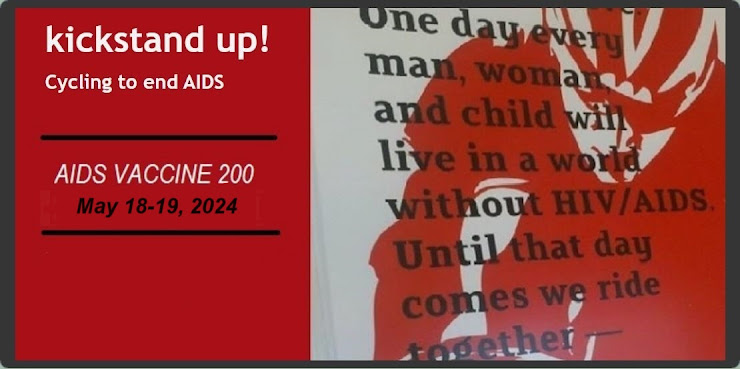
Last summer I rode in the 10th anniversary of the AIDS LifeCycle. This summer I’ll return to honor the 10th anniversary of the AIDS Vaccine 200, supporting HIV vaccine research at the Emory University Vaccine Center, with my Puget Sound Rider co-captains, Mary and Jon. In September I’ll celebrate the 10th anniversary of my and Mary’s thousand mile pedal down the west coast with a grassroots return to the NYC-DC route in a “Stealth Ride”, once again supporting Dr. Yuntao Wu’s research to end AIDS.

The cause of ending HIV/AIDS may no longer have the backing of high profile promoters but the ongoing efforts of many, backed by so many more, will bring the end of AIDS within our grasp and keeps hope alive for the journey.
"Never doubt that a small group of thoughtful, committed citizens can change the world. Indeed, it is the only thing that ever has." - Margaret Mead

Thursday, December 1, 2011

Risk Takers

My spin class recently ventured outdoors on a crisp, fall Saturday when halfway around the lake, Paul asked about the AIDS reference on my jersey. Then began to tell his story…

Pedaling and listening, I was finally able to answer the long awaited # 1 question in my ALC Top 10. The question I’m most frequently asked about riding is what keeps me going. My off the cuff answer tends to reflect my last ride – the sunny day, the camaraderie of my ride buddies, the scenery, etc. – but I struggled to find the common denominator in the many inspirations that keep me coming back for more, year after year.

Paul’s story began in a familiar way. This Midwest bike shop owner was ready to jump in and make a difference. He could have chosen to lend his bike mechanic skills to any number of charity events but Paul wanted to better understand his anxiety over this disease and the people affected by HIV/AIDS so he signed up to crew the world’s largest AIDS ride.

I took on that very ride for the first time this summer – the AIDS LifeCycle. Listening to Paul, my mind flashed back to the evening of Day 3. We’d arrived at our Paso Robles fairgrounds camp early enough for the sun to dry our wet towels hung over the tents before packing them away at nightfall. Our small team met early for dinner and enjoyed relaxing in the large hall with about 2000 other riders and crew waiting for the evening program to begin. Promptly at 7:30p, after our nightly update on the next day’s route and weather, the program began with remarks from a fellow ALC10 cyclist who spoke of his personal experience as an HIV+ man fighting AIDS in the early days, some 20-30 years ago. His description of those early struggles was meant to highlight how far we’d come by the efforts of such a diverse community of committed, caring individuals undeterred by the stigma of AIDS. The talk ended by recognizing today's community in this room of 2000+ cyclists and roadies – gay, lesbian, HIV+, young, old, transgender, gender-neutral and their “straight allies.” 

Paul knew the AIDS rides attracted a gay and lesbian community so he arrived in San Francisco with an open mind, withheld judgment and, over 7 days and hundreds of miles of flat tires and broken part replacements, was bold enough to admit his ignorance and accept their guidance to navigate this unfamiliar culture in a positive and caring way. Because Paul took a risk he soon no longer saw diseased homosexuals, he saw hurting friends. And Paul returned to help them, year after year.

Navigating the stigma of HIV/AIDS has challenged every prevention and treatment approach, worldwide, since the pandemic was first identified. Thirty years of HIV education programs have explained that HIV can spread by such acceptable activities as married heterosexual sex, a blood transfusion or a medical professional’s accidental finger prick yet the belief persists that the scourge of AIDS is due consequence for engaging in illicit or risky behavior. Hard to imagine it has been less than one year since Uganda considered a “Anti-Homosexuality Bill” giving government license to execute a homosexual infected with HIV.

Ironically, risk takers have been the driving force behind rapid progress to slow both the spread of HIV and its progression to AIDS: the San Francisco gay community exposing itself to call worldwide attention to a new, deadly pandemic; Ugandan midwives dispensing HIV treatments to every birthing mother in order to protect the newborn without exposing the HIV+ status of any one mother; the mayor who risks reelection to advocate for a clean needle exchange program; the teenage hemophiliac who went to court to overturn his expulsion from an Indiana public school; research scientists who reach a dead end only to test yet another theory. Fitting right in with these risk takers who make the most meaningful impression to keep me involved in these events are the unemployed woman taking time away from her lengthy job hunt to arise at 4am and serve breakfast to 3000 ride participants, the novice cyclist completing his first 100-mile day, the HIV+ peddler closely tracking his heart rate and hygiene, the elderly couple who empties their wallet to make a donation to a passing cyclist and especially those who risk opening their minds and their hearts to extend compassion without boundaries or qualifications.

This World AIDS Day, I invite you to take a risk. Take just one step further than you’ve gone before toward ending the stigma attached to HIV/AIDS. Learn more about HIV/AIDS - how it spreads, who it affects, how it is treated. Teach a child. Volunteer. Reach out to someone affected by the disease and offer your support. You have an open invitation to join me on any AIDS ride. If I'm not already registered, I'll sign up to keep you company or simply help you prepare. Extend compassion without boundaries or qualifications and AIDS doesn't stand a chance.

Some favorite World AIDS Day resources:

Tuesday, September 20, 2011

Top 10 of ALC10 – Red (Dress) Day

**Post is dedicated to the men and women busy being “all that you can be” who can now also proudly be all that they are in service to their country**

#2 – What’s with all the crazy red outfits?

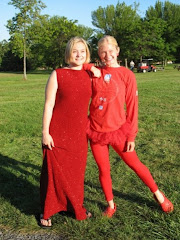
Every multi-day AIDS ride includes one day reserved for wearing red. Veteran AIDS cyclists likely have an entire red wardrobe from which to make annual selections and are giddy stumbling across just the right article of clothing or accessory throughout the year.


My daughter (in addition to glamorizing the lunch stop) introduced red nail manicures the night before Empire State AIDS Ride Red Days leading to a growing supply of polish shades and the discovery of travel remover wipes.


After his 2008 road crew stint, a red jersey was gifted to me by my son. It became the base of my red Ride wardrobe and enough to take my place in the ribbon of ALC10 red winding through the California hillside while marveling at the creative expression that comes from providing a safe atmosphere for anyone and everyone to be all that they are!


Watch and listen as the two people closest to the source of this tradition offer their version of the story in this video shot amid the spectacle that was the 10th AIDS LifeCycle Red (Dress) Day.

Thursday, July 21, 2011

Top 10 Continues

Bret’s birthday seemed the best time to follow through on my promise to complete this list of the Top 10 questions asked about my cycling escapades beginning with a few fun ones:

5. What kind of seat do you have?

When asked by a novice, I know the underlying actual question is more along the lines of “What seat could possibly be comfortable enough for all those miles when my ass is in agony after only a quick trail ride?!”

The answer is always “less is more” which draws puzzled looks so is followed by this story… When I signed up for my first multi-day ride, Steve and I owned a sign shop conveniently located across the street from a bike shop owned by another husband/wife duo interested in upgrading their signage, thus opening trade negotiations. Manny rolled over to our shop one day testing a new bike and suggested I try out its incredible, full suspension seat that was indeed as comfy as a lazy-boy on the behind and would surely bounce so lightly over any rough road that this princess would never feel a single tree root bulging through the asphalt trail.

Manny might have made a sale on the spot but was a better friend, or perhaps could tell he'd more likely make a customer for life by choosing honesty over the quick sale. Instead, Manny told me “less is more” – less for delicate parts to rub against every single time your leg rotates against it – followed by the real answer I needed to hear,  
“Tracy, the only way to stop your ass from hurting when you’re in the saddle is to keep riding.”  
For the next 3-4 years, the # 1 goal for each of my multi-day rides was not to finish first or even to finish fast but to sit down on day 2 without pain.

For the record, CC has a Terry Gellissima but I prefer Stellar’s Serfas Curva bike seat.


4. “What kind of bike should I get?”

Short answer – One that fits. I’ve already made the assumption you intend to actually ride this bike so making sure the frame fits your body and how you plan to ride (upright or bent-over) is absolutely the most important feature to consider. Everything else can be easily customized to your personal preference and budget. Don’t be fooled by charts using only your height for determining frame size. So much more is involved! Stand any 5 people of the same height side-by-side and you’ll quickly understand why this is true. I rode with aching knees for 2 years before someone told me my bike didn’t fit. I bought a bike that fit me and the knee pain instantly vanished.

This is where I turn you on to the experts I’ve relied on for 12 years and about 20,000 miles to build and service my bikes – R+E Cycles – pioneers and masters of a proper bike fit. Located in Seattle, R+E goes out of their way to accommodate and sell about 22% of their hand-built bikes to out of state customers. Even if you don’t buy from R+E, you owe it to yourself to take advantage of their website FAQs and Articles sections so you can walk into your next bike purchase equipped with a better understanding of what you want and need.

If you do visit R+E, see Smiley and tell him GiGi sent you!
Meet CC! Fit by Smiley, wheels by John

3. “How do you climb a hill?”

One foot after the other?  You’ve read many posts about how slowly I ride but you never saw slow until you’ve watched me pedal up a mountain. It’s legendary. I’ve clocked roughly 3.2 mph on both the 4 mile final leg of the climb to the Mount St. Helen’s Johnson Ridge Observatory and the 1.75 mile 23% grade up Mountain Road to finish Day 6 of the Empire State AIDS Ride. Of course, I’m capable of faster speeds on more gradual grades but whether mounting a sudden wall or a 33 mile afternoon ascent of a Rocky Mountain pass, the key to making it to the top is distraction.

One can lean on all that skill gleaned from experts only so long. At some point, your body mechanics will fare better if your head stops trying to convince them to quit! A few of the ways I distract myself through hill-climbing:
Rodney, Tracy, Mary end Day 4 of 2002 Breakthrough Ride
  • Watch the scenery
  • Count how many cyclists pass me – “On your left!”
  • Name that road kill
  • Eat (not necessarily right after the road kill)
  • Sing every verse of “Amazing Grace”. ..in my head of course. Some people I know can sing like a bird while climbing a mountain. I am not one of them.
  • Drink
  • Count how many pedestrians pass me
  • Name the wild berry – a seasonal event
  • Sing “The Ants Go Marching”…usually out loud, in a long line of cyclists climbing very slowly through a particularly steep or narrow-shouldered section of road.
  • Start a conversation with the 1-2 people I pass, very slowly
  • Scope out home and garden ideas. After a two season search, I finally found a house with exactly the paint color combo I want to use on my house while on a short climb up W. Lake Sammamish Rd! 
  • Sing the “I Dream of Jeannie” theme song to kill the last song that got stuck in my head
  • Pray. This is high quality, you have my full attention, prayer time for everything BUT reaching the summit. I have complete faith in reaching the summit with all these distraction tools at my disposal.